Day5: Real-Time Customer Profile, the Assembly Engine
When you first land in AEP, the natural assumption is that customer data flows in and lands in some big table called "Customer Profile" where one row equals one person. That's the picture most people start with, and it's wrong in a way that matters.
The Real-Time Customer Profile is not a customer table. It's an assembly engine. It builds the view of a person on demand, every time something asks for it, by stitching together fragments that live across many datasets. Once that one idea clicks, everything from the last four days finally connects.
This post is about how that engine works, the one rule that catches every team off guard, and why getting the foundation wrong shows up as a profile problem later.
Where we are in the series
The four previous posts built up to this one. A quick map:
- Day 1 set the three layers, Ingest, Profile, Activate, and showed identity stitching for the first time.
- Day 2 zoomed out: AEP is the foundation, the other Adobe products (RTCDP, AJO, Target, CJA) sit on top and read from it.
- Day 3 went deep on XDM, the four layers of a schema, and the profile-versus-event split.
- Day 4 showed that the schemas you see in the UI are just the surface, and the Schema Registry holds the real JSON definitions underneath.
Day 5 is where all of that pays off. The schemas define the shape. The Schema Registry stores them. The Identity Service links the IDs. And the Real-Time Customer Profile is the layer that turns all of it into one customer view that journeys, audiences, personalization, and analytics can read.
What the Profile actually is
The simplest definition:
Real-Time Customer Profile is the service that builds a unified customer view across systems in near real time.
It pulls together three kinds of input:
- Profile attributes, who the person is. From Individual Profile schemas.
- Behavioral events, what the person did. From ExperienceEvent schemas.
- Identity relationships, which records belong together. From the Identity Service.
The output is one continuously updated profile that powers segmentation, journeys, personalisation, activation, decisioning, and analytics.
The mental model that makes it click
Three layers, in order:
- XDM defines the language.
- Identity Service connects the IDs.
- Real-Time Customer Profile assembles the actual person.
That sentence collapses a lot of architecture into something you can hold in your head. The Profile itself doesn't invent identity, doesn't define structure, doesn't decide what's an attribute and what's an event. It depends on the layers underneath to do their job, then it assembles.
A light analogy from AEM: this is the same pattern as rendering a page from a Content Fragment Model, multiple fragments, and a template at request time. The rendered page isn't stored as one finished document. It's assembled when someone asks for it. The Profile is that pattern applied to customer data instead of content.
The biggest insight: engine, not table
This is the part most teams get wrong on day one.
AEP does not store one clean row per customer. Underneath, it holds:
- Profile fragments across many datasets
- Event fragments across many datasets
- Identity relationships in the identity graph
When something requests a customer profile, the Profile service dynamically assembles the full view from those pieces, using three things:
- The identity graph, which links the IDs that belong together
- Union schemas, the combined shape of every profile-enabled schema for a class
- Merge policies, which decide which value wins when sources disagree
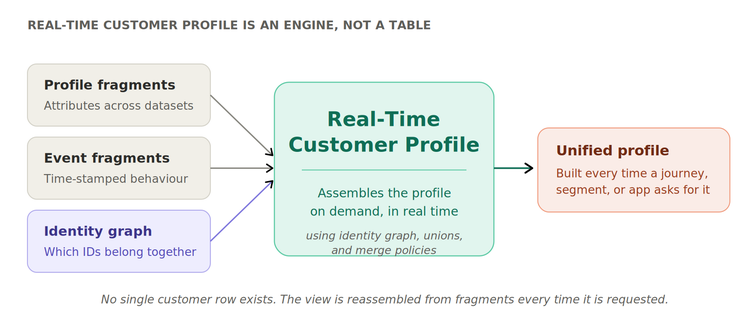
That's why the whole stack matters. Schemas matter because they define what fragments exist. Identities matter because they decide what links to what. Unions matter because they decide what shape the assembled profile has. Merge policies matter because they decide who wins when datasets disagree. Take any one of those out and the engine produces a worse profile.
The profile enablement rule
This rule catches everyone, so worth burning in early. Just because data exists in AEP, doesn't mean it reaches the Profile.
For data to feed the Profile, two things have to be enabled, not one:
- The schema must be enabled for Profile.
- The dataset must also be enabled for Profile.
Both. Not one. Both.
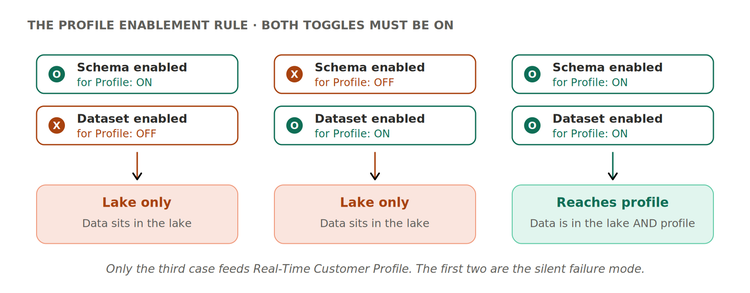
When teams say "the profile is incomplete" or "this customer isn't qualifying for the audience" or "the journey can't see this event," nine times out of ten the data simply never made it to the Profile layer because one of the two toggles was off. The data is sitting in the lake, valid and queryable, but invisible to the Profile.
This is the single most common silent failure in AEP. Check the toggles first.
What "real-time" actually means
It's not marketing language. In this context, real-time means:
- Profile updates happen as data lands, not on a nightly batch.
- Identity relationships update dynamically as new signals arrive.
- Audience membership can refresh within seconds for streaming-eligible rules.
- Journeys can react to live customer behaviour.
Take an example. Someone browses a product, adds it to the cart, logs in, then abandons the checkout. The Profile keeps assembling and updating that evolving state. Each event becomes available to Adobe Journey Optimizer and the Segmentation Service the moment it lands. That is what makes real-time triggers, suppression, and personalised offers possible. Without continuous assembly, journeys would be running on yesterday's view of the customer.
The Profile sits under everything
Loop this back to the foundation-and-apps picture from Day 2. The Profile is the surface that every app reads from:
- AJO checks the Profile before triggering or progressing a journey.
- Real-Time CDP activates audiences built from the Profile.
- Target personalises using the Profile's attributes.
- CJA reads from datasets, but live attributes flow through the Profile too.
- Segmentation Service evaluates audience rules against the Profile.
So the Profile isn't just a feature, it's the connective tissue. Every product on top reads from it, even though they each have their own console and their own job.
The dangerous part: the Profile amplifies your mistakes
This is the warning to sit with. The Profile does not fix a weak foundation. It amplifies it.
If the schemas are inconsistent, the identities are weak, the namespaces are wrong, the unions are messy, or the datasets are incomplete, the Profile inherits all of it. The downstream effects are predictable:
- Audiences include the wrong people.
- Journeys fire on bad signals.
- Profiles duplicate or wrongly merge.
- Analytics numbers stop reconciling.
- Personalisation feels broken to the customer.
This is the same warning from Day 2, now seen from the consumer side. The foundation work decides whether the program succeeds. The Profile is just where that truth becomes visible.
Problems teams notice too late
Most Profile issues don't show up on day one. They surface after ingestion scales, after journeys go live, after segments get more complex, after multiple teams start relying on the same profile data. The common shapes:
- Partial profiles, where attributes are missing
- Duplicate customers, where one person became two
- Incomplete stitching, where journeys can't see context from other systems
- Unexpected audience behaviour, where qualified people aren't qualifying
- Missing profile fragments, where one dataset never made it in
- Incorrect merge outcomes, where the wrong source's value won
Almost every one of these traces back to one of four things from the previous days: schema design, identity strategy, profile enablement, or union governance. Rarely to the Profile service itself.
The line that ties it together
If you carry one sentence out of this post, make it this:
Real-Time Customer Profile is not a customer table. It's a real-time profile assembly engine.
Once you hold that, unions, merge policies, profile fragments, identity graphs, and profile-enabled datasets all stop being separate concepts. They're inputs to the same engine.
What comes next
Day 6 goes into merge policies: how the Profile decides which value wins when multiple datasets disagree about the same field. That conversation makes sense only once you accept that the Profile is assembled from many sources, not stored as one row. Which is exactly what this post was about.