Day4: Schema Registry, the Hidden System Controlling Your AEP Architecture
When you first build schemas in AEP, it's easy to think you're just filling in fields on a screen. You pick a class, attach some field groups, mark a few identities, save. It feels like configuration.
It isn't. Underneath that screen is a whole system managing schemas, classes, field groups, identities, descriptors, versioning, and validation.
That system is the Schema Registry. Once you see it, AEP stops looking like screens and forms and starts looking like a real enterprise data platform with an API underneath.
This is a familiar shift if you come from AEM. You already know the UI is just one way in, and that the real definitions live in the repository and are reachable by API. The Schema Registry is that same idea for customer data.
What the Schema Registry actually is
The simplest way to say it:
- If XDM is the language of AEP, the Schema Registry is the dictionary and the rulebook.
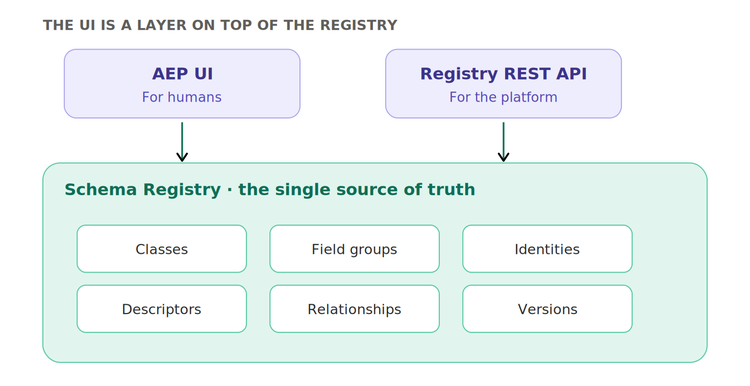
It's the central system inside AEP that stores and manages:
- All XDM schemas
- All classes
- All field groups and data types
- All descriptors
- Identity configurations
- Schema relationships
That makes it the single source of truth for what valid XDM looks like in your organisation. Without a central registry, schemas drift, environments fall out of sync, identities break, and governance becomes impossible.
The part most beginners miss
When you create a schema in the AEP UI, you're not really working in the UI. You're talking to the Registry underneath it.
- The UI is a layer on top.
- The real schema definitions live in the Registry.
That changes how you think about the work:
- Not "I'm configuring fields on a screen."
- Instead "I'm defining the schema architecture for the platform."
Where AEP starts feeling like engineering
The Registry isn't only reachable through the UI. It exposes a full REST API. Everything you can create by hand, you can also create programmatically:
- Schemas
- Field groups
- Data types
- Identity descriptors
- Relationships
This is the point where AEP feels less like a marketing tool and more like infrastructure. The mental model that helps:
- The UI is for humans.
- The Registry is for the platform.
- The Registry holds the actual architectural truth.
That's why schemas are addressable, resources have IDs, versions can evolve, validation happens centrally, and environments can stay consistent.
How schemas are stored
Inside the Registry, a schema isn't a UI object. It's a structured JSON definition, which means your schema is effectively a machine-readable architecture document.
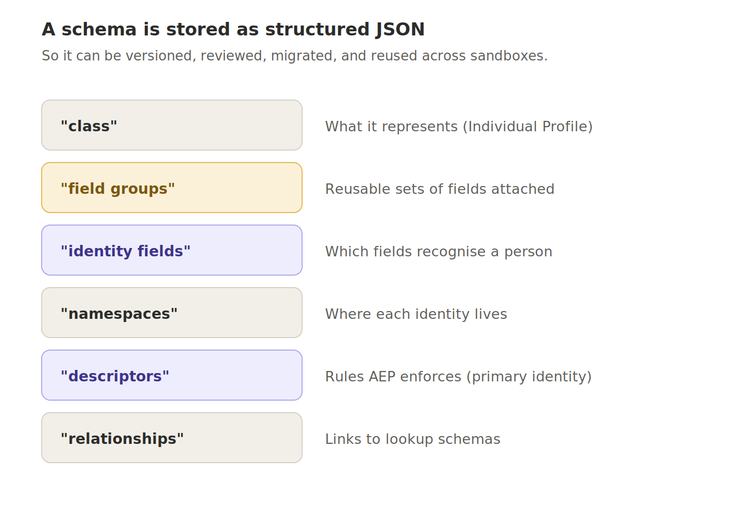
- Versioned
- Reviewed
- Migrated between environments
- Compared across sandboxes
- Reused
This is why enterprise teams lean on the Registry APIs instead of clicking through the UI for everything.
Identity configuration, where it gets serious
Identity is one of the most critical things the Registry holds, because identity fields aren't just labels. They become descriptors stored and enforced in the Registry. They tell AEP:
- Which fields are identities
- Which namespace each one belongs to
- Which identity is primary
- How profiles should merge
Get these wrong and every downstream system inherits the damage:
- Broken stitching
- Duplicate customers
- Collapsed profiles
- Inaccurate audiences
- Unreliable journeys
Identity architecture is one of the highest-risk design decisions in the platform, and the Registry is where those decisions are enforced.
The mistakes teams notice too late
Most schema mistakes don't fail right away. They fail after ingestion starts, after journeys go live, after profiles merge, after analytics starts reporting numbers that don't line up. Three are worth calling out.
Mistake 1: UI-only schema design. Teams build schemas by hand with no governance or documentation. It works at first. Later, environments drift, nobody knows what changed, production differs from dev, and debugging gets painful. The fix is to treat schemas like code.
Mistake 2: Overgrown field groups. Teams keep adding fields to shared field groups forever. Schemas bloat, governance gets hard, and downstream apps inherit complexity they don't need. The Registry rewards reuse, but only with a real reuse strategy behind it.
Mistake 3: Identity drift. Over time, namespaces change, fields get repurposed, and identities evolve differently across systems. The identity graph turns unreliable, and that ripples into the profile, segmentation, journeys, personalisation, and reporting all at once. This is the dangerous one.
The realization that ties it together
The line that reframes the whole thing:
The Schema Registry is not storing schemas. It is enforcing the architectural rules of the entire platform.
That's why it controls consistency, identity behaviour, schema evolution, governance, and how every downstream app behaves. Without it, AEP would just be disconnected datasets with no shared structure.
Why this reaches past the technical team
It's tempting to file the Registry under "engineering only." It isn't. Weak schema governance eventually shows up as:
- Inaccurate audiences for marketers
- Broken reporting for analysts
- Failed personalisation
- Duplicate messaging to customers
- Inconsistent customer experiences
Most business users never trace it back, but the root cause started at the schema layer.
What comes next
Day5 goes into identity resolution: how AEP takes scattered fragments about one person and stitches them into a single profile. That's where the identity graph and merge policies live, and it's where most teams spend their debugging time. The descriptors you set in the Registry are exactly what drive it.