Day1: How Experience Cloud Products Connect
Day1 is the framing Episode of AEP. It sets up one idea: AEP exists to connect a customer's full story/journey across disconnected systems, and everything in the platform falls into three layers
- Ingest
- Profile
- Activate.
This mental mode is correct and worth locking in before anything else.
since, I already know the Adobe stack from the AEM and Workfront side, the fastest way to absorb this to map the marketing level layers to the actual services that we'll click in the AEP UI. That bridge is the real Day1 win.
Day1:
Read the episode once for the story, then re-read it through this mapping so the abstract layers become concrete service names.:
Ingest:
Ingest means
- sources(connectors) plus Datasets.
Collect data from websites, apps, CRMs, POS systems, offline files, and streaming events.
Profile:
Profile means three things working together:
- XDM Schemas (Data Model)
- Identity Service (How records get stitched)
- Real-Time Customer Profile(Unified Record that results)
Activate:
Activate means:
- segmentation/Audiences
- Destinations(where audiences go) and
- Journeys via AJO.
So the Ingest -> Profile -> Activation
flow really sources to
Data -> Schema/Identity/RTCP -> Audiences/Destinations/AJO
Day1 Practice:
Don't build anything yet. The goal today is orientation, not creation.
Get into a sandbox. If you have an access to AEP, use the dev sandbox. If not, Adobe's Experience League has guided tutorials with a sample environment, and that's enough to follow along.
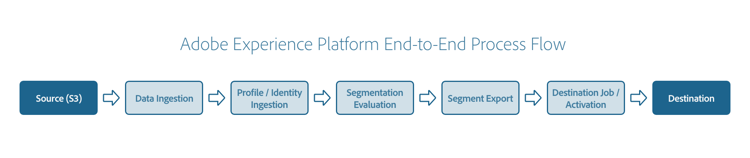
The standardized framework by which Experience Platform organizes customer experience data. To best make use of Segmentation, please ensure your data is ingested as profiles and events according to the
Experience Data Model (XDM):
The standardized framework by which Experience Platform organizes customer experience data. To best make use of Segmentation, please ensure your data is ingested as profiles and events according to the best practices for data modeling.
Identity Service:
Provides you with a comprehensive view of your customers and their behavior by bridging identities across devices and systems.
Sources:
Experience Platform allows data to be ingested from various sources while providing you with the ability to structure, label, and enhance incoming data using Experience Platform services.
Segmentation Service:
Segmentation Service allows you to divide data stored in Experience Platform that relates to individuals (such as customers, prospects, users, or organizations) into smaller groups.
Real-Time Customer Profile:
Provides a unified, real-time consumer profile based on aggregated data from multiple sources.
Datasets:
The storage and management construct for data persistence in Experience Platform.
Destinations:
Destinations are pre-built integrations with commonly used applications that allow for the seamless activation of data from Experience Platform for cross-channel marketing campaigns, email campaigns, targeted advertising, and many other use cases.
Open the left nav and physically locate each service from the mapping above: Sources, Schemas, Datasets, Profiles, Segments (Audiences), Destinations, Journeys. For each one, just read its landing screen and ask "which of the three layers is this." That single exercise makes the rest of the series click.
If a sandbox already has sample data, open Profiles, search for a test profile, and look at how it shows attributes and identities from multiple sources merged into one view. That's the whole point of the platform shown in one screen.
AEM VS AEP
AEM whole world is content and assets. AEM is a content and delivery platform.
AEM answers "what should this person see, and how do we manage and deliver it."
AEP is a customer data platform.
AEP answers a completely different question: "who is this person across every system, and what have they done."
They sit in the same Experience Cloud family, but AEP holds zero pages and zero DAM assets. It holds data about people and their behavior.
If you remember one line, make it this: AEM is about content, AEP is about identity and data.
The three pillars, with the real services underneath
Ingest, Profile, Activate.
Here's what each one actually is when you log in.
Ingest (Data In):
This is Sources plus Datasets. Sources are connectors that pull data from web, mobile, CRM, POS, cloud storage, and streaming events.
Conceptually this is the closest thing to what you know from Fusion connectors, data coming in from many systems, except in AEP it's declarative and built for huge volume.
Data arrives in two speeds:
batch (a nightly CRM file) and streaming (a website event firing the moment it happens). Everything that lands gets stored in a Dataset.
Profile (Unified View):
This is the heart of the platform and where the real learning is.
It combines three services:
- the data model (XDM Schemas),
- the Identity Service, and
- the Real-Time Customer Profile.
This pillar is what turns a pile of disconnected records into one "Real-time Human Record".
Activate (Action Out).
This is Segmentation (Audiences), Destinations, and Journeys.
You define an audience like "people who abandoned a cart but haven't purchased," then send it to a Destination (email platform, ad platform, call center) or run it through a real-time Journey in Adobe Journey Optimizer.
The concept that unlocks everything: two kinds of data
In AEP, all data is one of two types.
Record data is who someone is. Attributes that describe a person: name, email, loyalty tier, city. It's relatively stable. In AEP this uses a schema built on the XDM Individual Profile class.
Event data is what someone did. Time-stamped behavior: viewed a page, added to cart, opened an email, made a purchase. It's a constant stream. This uses a schema built on the XDM ExperienceEvent class.
Here's the anchor to AEM world. An XDM Schema is very close to a Content Fragment Model in AEM. Just like you define a CF Model before you can author structured content, in AEP you define an XDM schema before any data can land.
The schema is the contract. The Dataset is where the instances get stored.
Identity stitching, the part with no AEM equivalent
This is the new muscle you have to build, because nothing in Sites, Assets, EDS, or Workfront works like it.
Every record you ingest carries one or more identifiers, and each lives in an identity namespace (Email, ECID for the web cookie, CRM ID, Phone, Loyalty ID, or custom ones).
When you build a schema, you mark certain fields as identities and pick one as the primary identity. The Identity Service then watches for overlaps. If a web event carries both an ECID and an email, and a CRM record carries that same email and a CRM ID, AEP draws the links and concludes all of it is one human. That linking map is the Identity Graph, and the merging is identity stitching.
The result is the Real-Time Customer Profile: one record that pulls attributes and events from every dataset, governed by merge policies that decide which value wins when two sources disagree.
Let me show you that visually, because the prose only takes you so far on this one.
Here's that stitching visually. Four systems each know the same person by a different key. The Identity Service links those keys into one graph and produces a single profile.
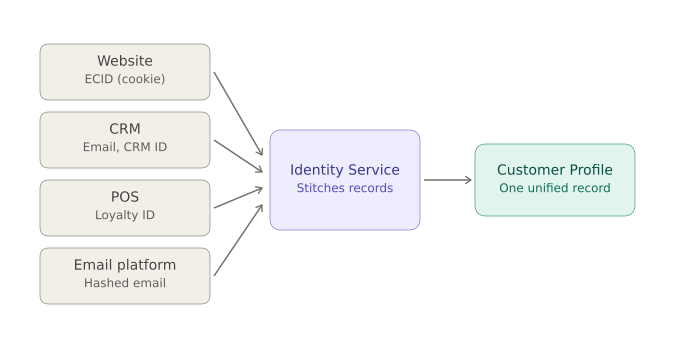
The trick most newcomers miss: the four systems on the left never had to change. AEP doesn't force every system into one database. It reads them where they are and links the identities at the platform level.
Once stitched, an event from any system updates the same profile, so a journey can react in real time.
That's how you avoid the "buy now" email. The purchase event hits the profile instantly, and the journey suppresses or changes the next message.
Your AEM-to-AEP cheat sheet
Lean on these mappings while you learn. They're not perfect, but they get you oriented fast.
XDM Schema is like a Content Fragment Model. You define structure before any data exists.
Sandbox is like your AEMaaCS dev, stage, and prod environments. Isolated workspaces inside one AEP instance.
Sources and Destinations are like Fusion connectors, data in and data out, but declarative and built for scale.
Dataset is like a table. It's where data based on a schema actually lands.
Real-Time Customer Profile is the golden record. There's no real AEM equivalent, this is the new thing.
Identity namespace and identity stitching also have no AEM equivalent. This is the muscle you build from zero.
What to explore first, in order
Don't try to learn everything at once. Go in this sequence and the platform stops feeling massive.
First, the record vs event distinction. If you can look at any field and instantly say "that describes who they are" or "that describes what they did," you've understood half of AEP.
Second, schemas and classes. Build one Profile schema and one ExperienceEvent schema in the sandbox. This is where your CF Model instinct pays off.
Third, identity. Mark identity fields, pick a primary identity, and watch two records merge into one profile. This is the concept that separates people who "know AEP" from people who just talk about it.
Everything after that, segmentation, destinations, RTCDP, and AJO, sits on top of those three.
The episode's promise about "how Experience Cloud products connect" is really just this: RTCDP, AJO, and Customer Journey Analytics are all apps that read the same profile and the same schemas you'll build.
Learn the foundation once, and those apps become easy