Day 1 to 7 Recap: Where You Stand After the First Seven Days
Seven episodes in, it's worth stopping to look at the shape of what we've covered. Individually, each post tackled one topic. Together, they add up to something specific: the complete data foundation of Adobe Experience Platform, from raw data coming in to a live audience going out.
This is a checkpoint. No new concept here, just a clear view of what you now understand and where you stand before the next phase.
The one frame that holds it all
Day 1 set up three layers: Ingest, Profile, Activate. Everything since has been filling in those layers. Here's the whole series mapped back onto that original frame.
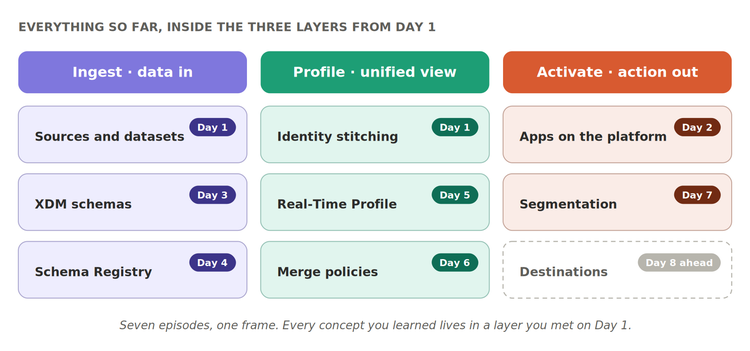
The seven episodes, one line each
- Day 1, the three layers. The map of the whole platform, plus your first look at identity stitching and the AEM-to-AEP translation.
- Day 2, foundation and apps. AEP is the base. RTCDP, AJO, Target, and CJA are applications that read from it.
- Day 3, XDM. The data model. Classes, field groups, identity fields, and the profile-versus-event split that breaks projects when ignored.
- Day 4, the Schema Registry. The UI is just a surface. The real schema lives as JSON underneath, governed centrally.
- Day 5, Real-Time Customer Profile. Not a table, an assembly engine that builds the customer view on demand.
- Day 6, merge policies. The rulebook that decides which value wins when datasets disagree.
- Day 7, the Segmentation Service. Audiences are continuously evaluated rules, not static lists, running at batch, streaming, or edge speed.
Trace one customer through everything
Here's how it all connects in a single story. A shopper browses a product, adds it to the cart, and leaves. The next day they buy it in a store, and they're also a known CRM customer.
- The web event and the store sale arrive through sources and land in datasets (Day 1).
- Both conform to XDM schemas, one for the profile, one for the event (Day 3), defined and governed in the Schema Registry (Day 4).
- The shared email lets identity stitching link the web cookie, the loyalty ID, and the CRM record into one person (Day 1).
- The Real-Time Customer Profile assembles that person on demand from the fragments (Day 5), and merge policies decide which email or address wins (Day 6).
- The Segmentation Service continuously checks whether this person now belongs in the "purchased, stop retargeting" audience (Day 7).
- The apps on top then act on it (Day 2), which is where the next phase begins.
If you can follow that paragraph end to end and name which episode each step came from, you've understood the foundation.
Where you stand now
After seven episodes, here's what you can actually do, not just recognize.
- Read any AEP architecture diagram and place each box into Ingest, Profile, or Activate.
- Look at any field and say whether it's profile data or event data, and why that matters.
- Explain why a schema mistake quietly breaks identity, profiles, segments, and reports downstream.
- Understand that the customer profile is assembled on demand, not stored as one row.
- Explain why two teams can see different versions of the same customer, and trace it to merge policies.
- Explain why some audiences update instantly and others lag, and trace it to batch, streaming, or edge.
- Diagnose the most common AEP failure on sight: data that never reached the profile because a schema or dataset toggle was off.
That's a real working mental model of the platform, not surface familiarity.
What you can't do yet
Worth being honest about the edges, so you know what's still ahead.
- Activate audiences to real destinations like Google Ads or Meta (Episode 8).
- Build and orchestrate journeys in Adobe Journey Optimizer.
- Run cross-channel analysis in Customer Journey Analytics.
- Go deep on the identity graph mechanics and identity resolution at scale.
- Handle consent, governance, and privacy across a real program.
- Operate any of this at production data volumes, where the hard problems actually live.
The one lesson under all seven
If there's a single thread running through every episode, it's this: the foundation decides everything downstream. Day 3 said a weak schema breaks identity. Day 5 said the profile amplifies your mistakes. Day 6 said merge policies can't fix bad stitching. Day 7 said segmentation is only as good as the profile underneath. Same lesson, seven angles.
That's not a coincidence. It's the most important thing to carry forward. The flashy parts of AEP, the journeys and the personalization, are only as trustworthy as the quiet foundation you've spent seven episodes learning to build.
What comes next
Episode 8 starts the activation phase: how audiences leave AEP and become usable in the channels and tools that actually reach the customer. The foundation is built. Now we make it do something.